
French Wall Art: The Art of a Collected Parisian Home
Buying art for a room that is already finished can be surprisingly difficult. By then, every colour has been agreed on and every space has a purpose. A painting is expected to fit in. The homes that hold our attention tend to suggest a different order of events: someone wanted the painting enough to make room for it.
That is the appeal of the collected Parisian home. You can imagine someone choosing a picture without first checking the upholstery. There is confidence in allowing a work to look slightly unexpected, and in keeping it when the rest of the room changes.
French wall art is a useful starting point for exploring that approach, although the phrase covers far more than one style. A French painting may be entirely abstract; a Parisian home may be full of work made elsewhere. What interests us here is how art is chosen and lived with, rather than a particular image of France.
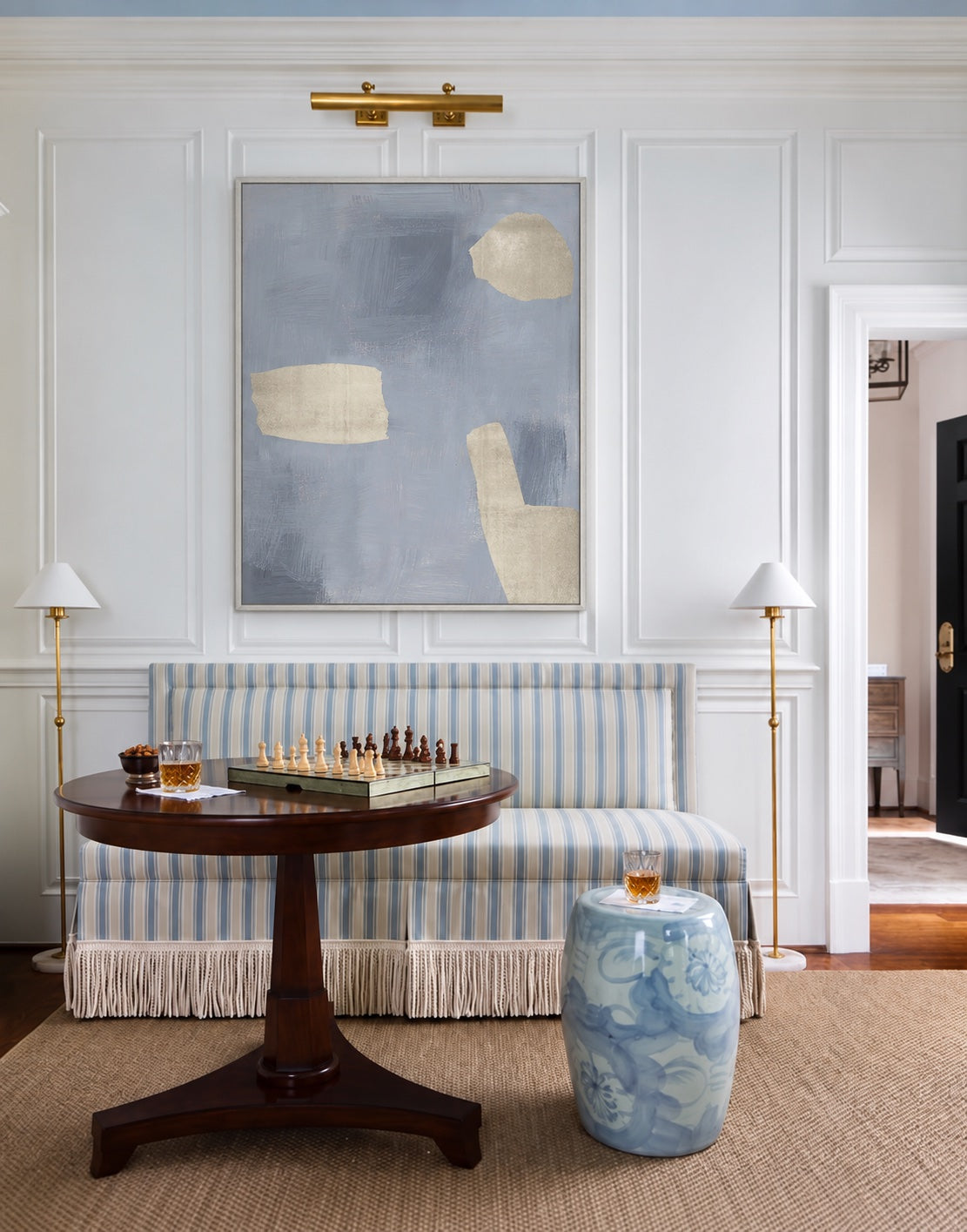
In the first room, Lulled to Sleep 4 sits beneath the brass picture light. Its blue-grey ground relates to the bench, while the larger cream shapes give the painting a composition of its own.

A Painting Does Not Have to Match
It is tempting to choose a picture by colour, particularly when a room has taken months to put together. There is nothing wrong with wanting it to look good above the sofa. But matching every tone can make the artwork feel like another furnishing, leaving little reason to look at it closely.
A work with a colour you would never use on the walls can be much more rewarding. It gives the room something you would not have arrived at through decorating alone. The same is true of subject matter: being drawn to a portrait does not require a room full of portraits. One can be enough.
This also makes buying art less dependent on the home you happen to have now. A picture chosen for its own sake has a better chance of following you to the next one.

The pale green of Moss changes the white room below without adding another detailed pattern. The square format leaves the wall mouldings visible around it.


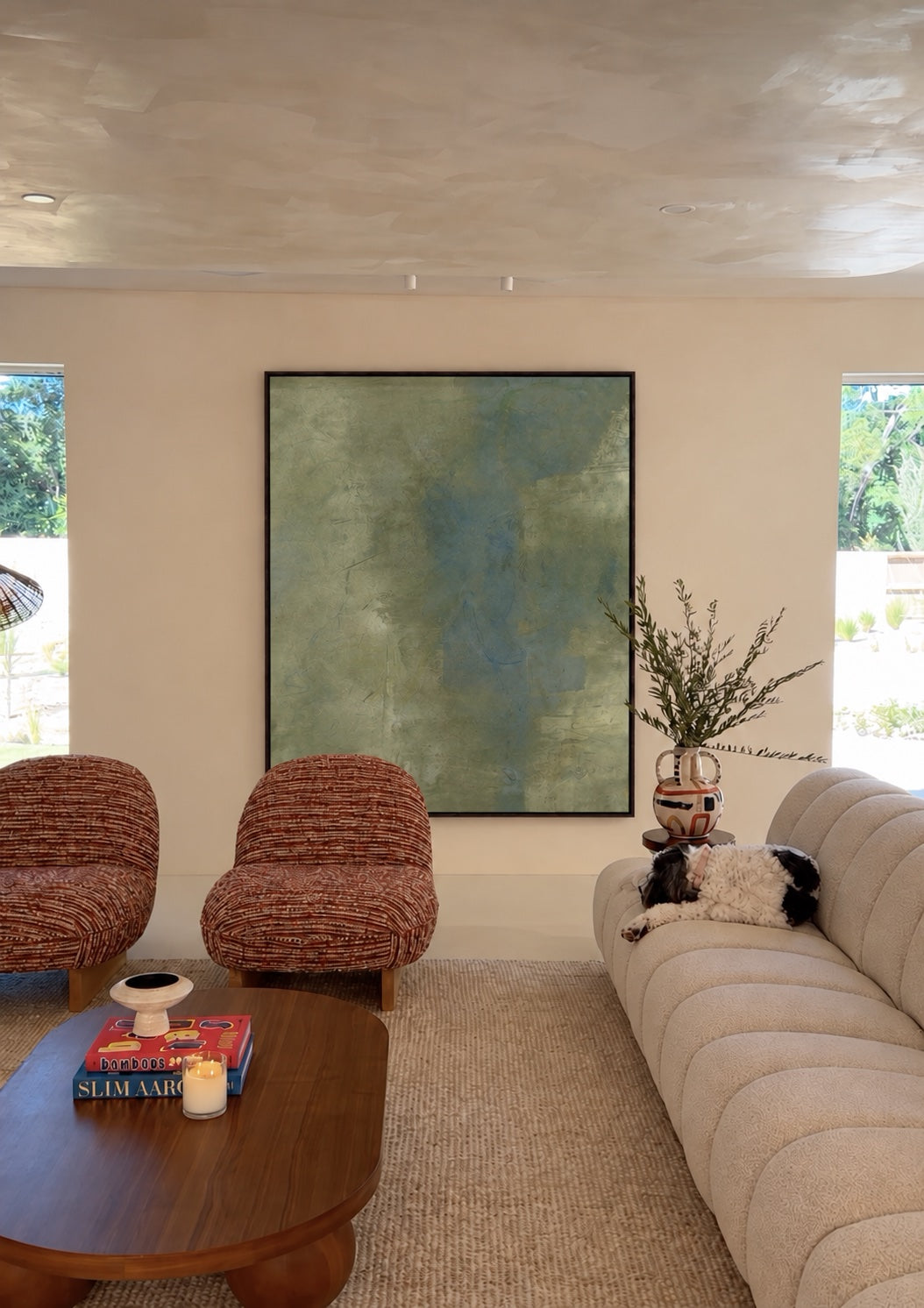
The rust-red chairs give Study of Green by Ronda Waiksnis a useful contrast. Seen from farther back, the darker frame helps the painting hold its place on the broad wall. Both views show the same work.

Why a Still Life Works at Home
A still life is an easy subject to underestimate. From a distance, the painting may appear to be little more than a bowl on a table. Looking longer reveals how much depends on the way it has been painted. The angle of the table can make the whole composition feel unstable; a thick passage of paint can give an ordinary object an almost physical weight.
There is something pleasing about living with a picture that rewards this kind of attention. Its subject is familiar enough to feel at home in a dining room, yet the painting offers a different way of seeing what is already there.
For a smaller apartment, a modest still life is worth considering. It can be seen properly at close range, which makes a place beside a favourite chair more useful than a large, distant wall. Small does not necessarily mean secondary.
Looking Beyond Paintings
Works on paper are worth spending time with, particularly at the beginning of a collection. A drawing lets you follow how an artist has worked through an idea. An unfinished area can be as interesting as the most carefully resolved part.
A print offers different possibilities, but the description matters. An original etching and a reproduction of a painting may both be enjoyable to own; they are different objects, and the price should make sense in relation to what you are buying. Ask how a work was made if the listing leaves that unclear.
Photography deserves the same consideration. A photograph does not need a recognisable Parisian setting to belong in this kind of interior. Its composition may be what first attracts you, or there may be something in the scene you cannot quite place. That can be a good reason to keep looking.

In the room with the zebra rug, Sketched Thoughts is deliberately spare. The fine lines offer something to examine up close, while the rug supplies most of the pattern in the room.


The two views of the desk show Abstract Village by James Pratt. Its loosely painted buildings give the eye something to return to beyond the books. The narrow warm frame is enough to separate the painting from the wall.

The Frame Can Change the Picture
Before dismissing a work in an unappealing frame, try imagining it without one. A heavy surround can overwhelm a small painting, while a mount that has yellowed may alter the way the colours appear. Sometimes the picture you like is already there, obscured by its presentation.
The reverse is true too. An old frame can be a substantial part of the pleasure of a work. Its proportions may suit the painting so well that replacing it would take something away. Age alone is not the deciding factor; the relationship is.
For a drawing or photograph, it is worth getting advice from a framer about materials and glazing. This is a practical decision with a visible result. The amount of space around an image can change how you look at it.

Above the fireplace, Blue Blush by Kiah Bellows brings a little blue and peach into the white setting. The small sculpture remains in front of it; the painting can be part of the mantel arrangement without every inch of it being exposed.

Hanging a Collection Without Overplanning It
A wall of pictures can feel surprisingly formal when every piece has been bought to fill a prearranged position. Starting with fewer works gives you a chance to see what each needs. You may discover that the painting intended for the centre looks better on its own, or that two small drawings belong together.
Lay a possible grouping on the floor before making holes, then consider it from where you actually sit. A composition that looks balanced while standing directly in front of it may feel awkward from the other end of the room.
Leaving some wall empty is useful. It gives you room to reconsider the arrangement when another work arrives. There is no need to treat a collection as finished simply because the room is furnished.
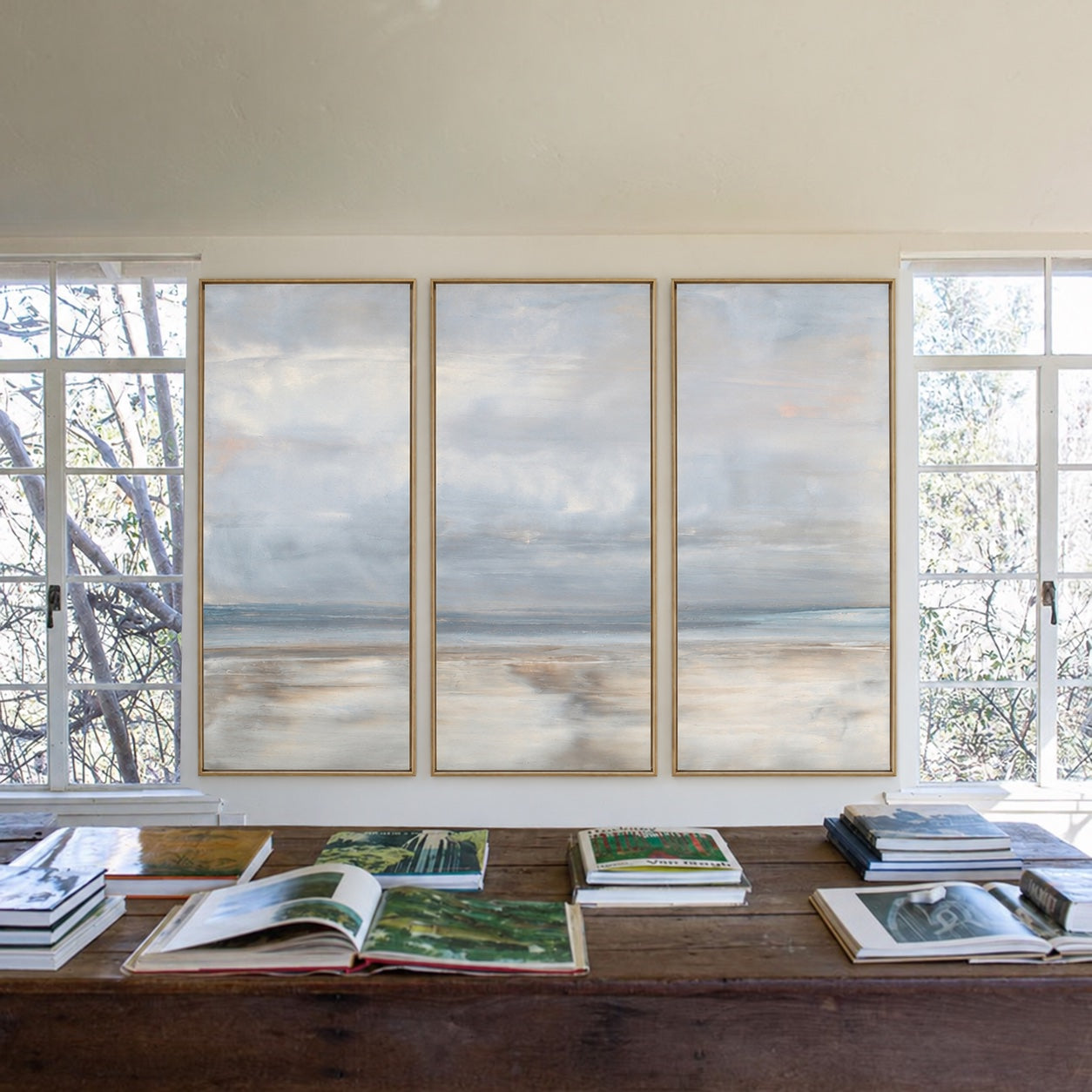
The Simpatico Triptych by Carol Benson-Cobb uses three panels to carry one view across the wall. Keeping their upper edges aligned makes the set read as a single composition between the windows.


The other arrangement combines Blue Blush by Kiah Bellows, Moss and Neutral Square, all from McGee & Co. They are separate works, brought together here by their pale colours and slim frames. The differences in their surfaces become more noticeable when they hang beside one another.

Choosing What You Want to Live With
Photographs of interiors tend to show art as part of a complete room. Living with it is a more individual experience. You may barely notice a painting during a busy week, then find yourself studying it one evening for no particular reason.
That is difficult to predict at the point of purchase. It helps to return to a work more than once, if possible, and to look beyond the first impression. What seemed immediately attractive may become less interesting; something you were unsure about may be the picture you keep thinking of.
There is room in a home for an inexpensive print bought because you love the image. There is also room to save for an original work. A collection need not resolve those choices into a single rule.

The wide format of Knowledge of the Stream by Tyler Guinn suits the wall between the curtains. Its muted olive colour gives the room a point of focus without competing with the smaller photograph below.

A Home With Its Own Point of View
The Parisian apartment is a useful reference because it allows for a certain independence of taste. Art can sit comfortably with furniture from another period, and a work can be kept for reasons that are not obvious to a visitor.
At Maison Quotidien, that is what makes a collected home interesting. You sense that someone has made decisions and continued to live with them. The art is part of those decisions, including the ones that would be difficult to explain to anyone else.

Over the wooden sideboard, Serene Skies II leaves the room feeling light. The broad brushwork is still visible from across the space, and the pale frame works with the white panelling.

French Wall Art Collection
Begin with the works in this story, then explore our wider edit of art for a collected home.


